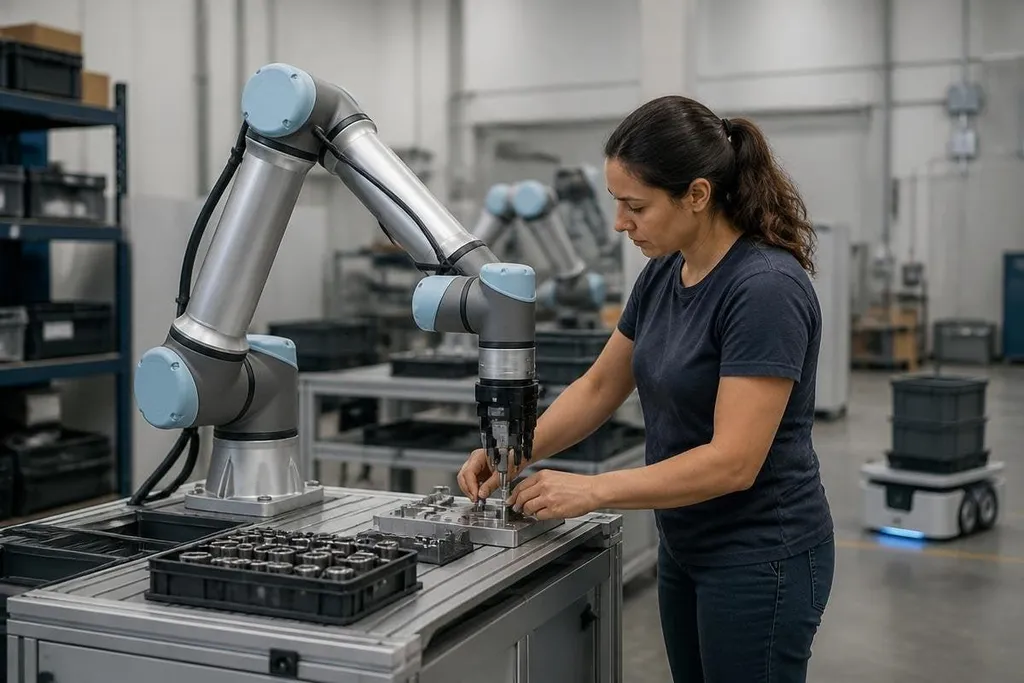
Collaborative robots are moving beyond fixed arms beside assembly workers. The next gains will come from better sensing, easier setup, safer motion, and clearer proof that a task works outside a demo cell.
- Force sensing can let an arm slow or stop when contact changes.
- Vision can help a robot find parts without fixed placement.
- Safety depends on the task, speed, reach, tool, and work area.
Force sensing that changes the task
A force sensor measures push and pull at the robot’s joints or wrist. That lets the arm detect contact instead of following position commands alone.
For a worker, the practical result is an arm that can fit a part, press a component, or stop when a hand enters its path.
The hard part is deciding what the contact means. A gripper holding a tight part needs enough force to finish the job. The same force against a person needs to trigger a stop. Better systems will need to read those changes without slowing every task to a crawl.
A good test asks for the force limit, the stop time, and the tool used during the test. A claim about safer contact has little value without those details.
Vision that cuts setup work
Many robot cells still depend on parts arriving in known positions. A camera can locate an object, estimate its angle, and send that data to the arm. The robot then adjusts its path instead of waiting for every part to sit in one exact place.
That matters most for short production runs and mixed parts. A worker may change the item or tray several times a day, so a long programming session can erase the labor savings from automation.
A useful step is better recovery. If the camera sees a blocked part or a failed grip, the robot needs to choose a safe next action. A system that finds an object once is less useful than one that can report the failure and wait for a person.
Easier programming without hiding the limits
Hand-guiding lets a worker move the arm through a task and save points along the path. Tablet controls and visual programming can also reduce the amount of code needed for a basic pick-and-place job.
Setup time still depends on the gripper, camera, part shape, and safety settings. A robot may learn the arm path in minutes, then need hours of tuning before it handles parts at different angles. Buyers should ask for the full setup time, not the fastest step in the process.
Those hours of tuning matter even more when a cobot leaves one fixed cell and takes on work in shared areas. Robot24 can connect that shift to the named machine, trial, and task, giving you the facts needed to judge mobile cobots.
Mobile cobots and shared work areas
A collaborative arm on a mobile base can serve more than one station. It may move between tasks, then connect to power or a work fixture at each stop. That can help a small factory avoid buying a separate arm for every bench.
The base brings new risks. The robot must stop for people, keep its balance, protect cables, and return to a repeatable position. A mobile system also needs a clear plan for charging, floor changes, and blocked routes.
The useful proof is a complete work cycle in the real space. A short clip of the arm moving on a clean floor leaves out the part that decides whether the system earns its place.
How to judge the next demo
I'd watch recovery behavior before a polished first attempt. A robot that notices a failed grip, stops safely, and asks for help may save more work than one that completes a perfect scripted cycle.
Use this checklist when a supplier presents a new collaborative robot:
- Name the task: record the part, tool, cycle, and target rate.
- Ask for contact data: request force limits and stop times for the exact setup.
- Test variation: change part position, lighting, or surface condition.
- Count human steps: include loading, fault recovery, cleaning, and resets.
- Check the safety review: confirm who assessed the robot, tool, base, and work area.
- Price the full cell: include grippers, cameras, fixtures, software, training, and service.
The advance worth buying will have a measured recovery process, a clear safety case, and a cycle time that holds after the first failed pick. Until suppliers publish those details, treat smooth demos as starting points rather than proof.